

The Rose-Knit Tea Cozy, the Tuesday Club and the Name That Wouldn't Come
A retired dressmaker who has poured for a parlor tea club since 2007 loses a neighbor's name mid-introduction; a librarian friend brings a box. The label, the honest research and the return terms, read like a pattern envelope.
At two minutes to three on the second Tuesday of February, I stood in my own parlor with a teapot in one hand and a perfectly good introduction stuck in my throat.

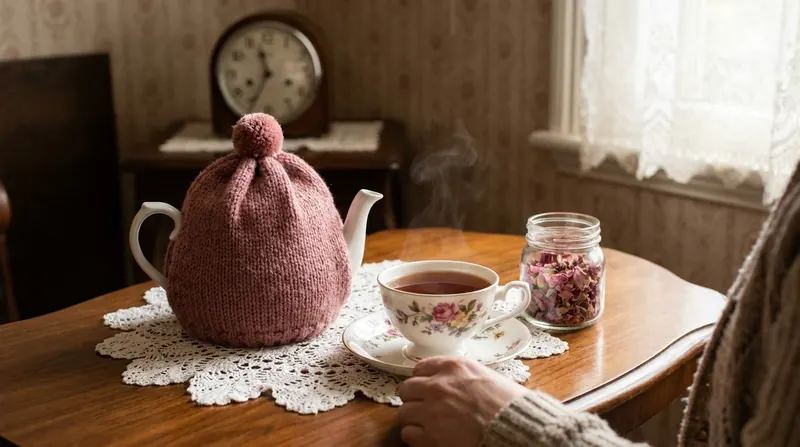 Tuesday Club · 3:00 p.m.
Bernadette Kowalski has lived across the alley from me for thirty-one years.
She fed my cat through two hip surgeries of Frank's and one of my own, and she taught me to put up peaches.
And on that Tuesday, turning to introduce her to a new member, I opened my mouth and her first name simply wasn't there.
It came back eleven seconds later.
I know it was eleven, because I was looking at the wall clock above the sideboard the whole time, pretending to check whether the kettle was due.
Nobody else noticed, or nobody said so. Bernadette laughed and introduced herself, the way you'd hand a pin back to a woman who'd dropped one.
But I noticed. I've been threading needles in poor light since 1971, and I know the difference between a dropped stitch and a seam that's starting to pull.
So this is a column about a tea club, a pincushion and a box of tea bags with a rose on the label.
It's also about what I found when I read that box the way I used to read a pattern envelope, front, back and the fine print on the flap.
If you've ever stood in your own kitchen waiting for a word that you've known for fifty years, you'll know most of this already.
You just haven't seen anybody count the seconds out loud.
Forty-One Years With Pins in My Mouth
I ran Duvall Alterations on Main Street in Galesburg, Illinois, from 1979 until the spring of 2020.
Hems, zippers, prom dresses taken in, funeral suits let out, and more wedding gowns than I could count.
The shop had a long oak counter that came out of a dry-goods store, and on the end of it sat a cut-glass bowl that was never empty of rose petals.
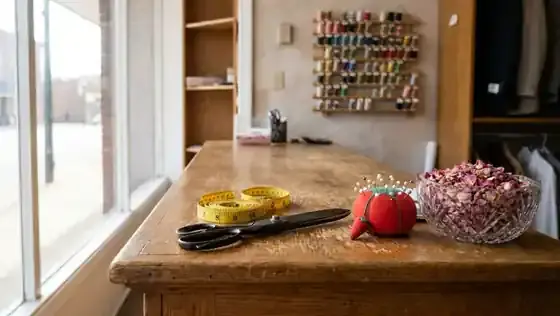
The petals were from the silk-rose work.
For thirty years I made the little fabric roses that went on bridal sashes and corsages, and every June I bought real ones to copy the curl of the petals.
When the real ones dried, I couldn't throw them out.
So they went in the bowl, and brides would put their hands in it while they waited for a fitting, like a dish of mints at the bank.
Petals on the counter all my life, my granddaughter says, and now they're in the cup.
She thinks that's funny, and so do I, now that I've had the spring to think about it.
Alterations teaches you one lesson above all the others. You never trust the tag; you measure the woman standing in front of you.
A size twelve from one maker is a size eight from another. The only number that means anything is the one on your own tape, taken twice.
I measured a lot of people twice.
I was the woman in the back room who noticed when a regular customer had lost weight she didn't mean to lose, and who said so gently, before anybody else did.
Here's the embarrassing part. I'd been dropping words for longer than that February afternoon, and I'd been filing every one of them under "tired."
The first entry I ignored was the shears. My good dressmaker shears, the ones nobody else is allowed to touch, kept turning up in rooms I didn't remember carrying them to.
The second entry was the grocery list. Three Saturdays running I came home from the Hy-Vee without the one thing I'd gone for, which was cardamom for the club's Swedish tea ring.
The third entry was the word "selvage," which I've said ten thousand times; it's the finished edge of a bolt of fabric that won't unravel.
In January I stood at the fabric store holding a bolt, and I had to describe it to the girl with my hands.
I'd have caught all three in a customer in one fitting.
In my own house, I needed Bernadette's name to go missing in front of the whole club before I'd take my own measurements.
A Tea Club Founded in a Front Room in 2007
The Tuesday club started the autumn after Frank retired from the railroad. He wanted the dining-room table for his model trains, so I took the parlor for my friends.
There were four of us that first Tuesday: me, Bernadette, Opal Fairweather from the public library, and Pearl Odom from church.
We drank rooibos because Frank liked it and because it doesn't have any caffeine to speak of.
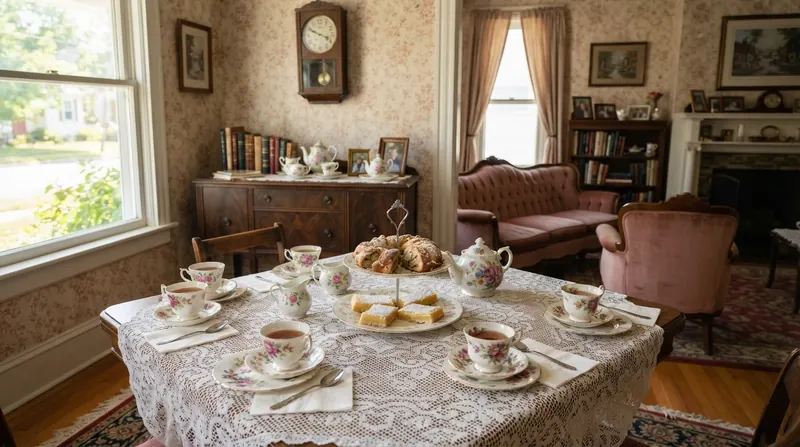
Rooibos is a red bush from South Africa, and it brews a cup the color of a good mahogany stain. For nineteen years it was the only tea the Tuesday club knew.
Frank used to come through the parlor at four o'clock on his way to the trains, take one cup standing up, and say "Ladies" like a conductor.
Then he'd disappear down the hall again.
He died four years ago this past September. The club kept meeting, because Frank would have been mortified to be the reason it stopped.
These days there are nine of us on a good Tuesday. We added Mavis Teague, who knits; Dee Archuleta, who brings the gossip from the courthouse;
and Gus Pawlak, a widower who came once for Pearl's lemon bars and never left.
The rules haven't changed since 2007. Three o'clock sharp, nobody brings store-bought anything, and the hostess introduces every new face by name.
That last rule is mine. I believe a name is the first thing you give a person in your house, before the cup.
Which is why the eleven seconds stung the way they did.
The one rule I wrote for my own parlor was the one I couldn't keep.
I've since named the club newsletter after our old pot, which is how this column got the title it has.
Rooibos Remembered started as a joke about Frank's tea and turned into the thing I write on Sunday nights.
The Afternoon the Name Didn't Come
I want to tell the eleven seconds properly, because I think most people skip the details of the moment and go straight to the worry.
It was a new member, a retired schoolteacher named June-Ellen, Pearl's cousin from Monmouth.
She was standing in my parlor doorway with her coat still on, holding a plate of shortbread wrapped in a dish towel.
I took the plate and turned to the settee, where Bernadette was sitting with Mavis.
I said "June-Ellen, this is my neighbor of thirty-one years," and then there was a hole where the next word should have been.
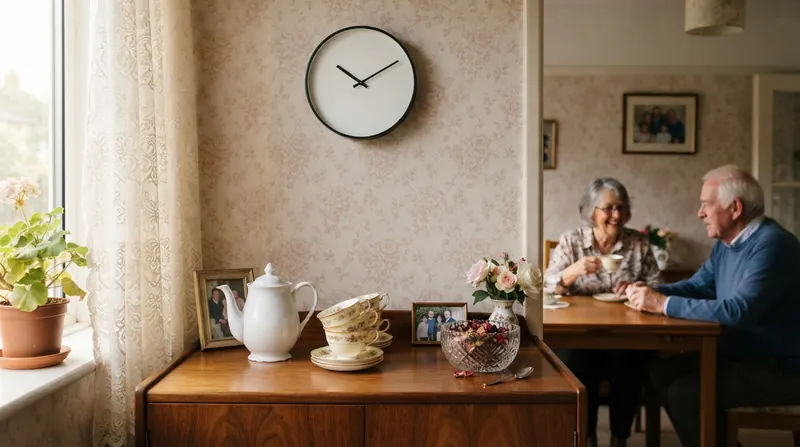
It wasn't a blank, exactly. I could see Bernadette's kitchen, her peach jars, the green cardigan she wears every Tuesday from October to April.
I could have told you the name of her late husband, her daughter in Peoria and her dog in 1998.
The one word I needed was behind a door, and I could hear it moving around in there.
Bernadette is a kind woman. She said "Bernie, and she's been trying to send me back across the alley since Reagan," and everybody laughed, and June-Ellen sat down.
I poured nine cups without losing a drop to the saucers. Then I went into the kitchen, ran the cold tap over my wrists and stood there until the kettle clicked off.
That night I couldn't concentrate on my library book.
I kept thinking about my mother, who poured for her own church circle until she was eighty-four, and who started calling all of us "dear" around seventy-eight because "dear" never has to be remembered.
I'm seventy-one. I don't think one slipped name is a verdict, and neither did my clinician when I mentioned it at my spring checkup.
But I'm a dressmaker, and when a seam starts pulling, you don't wait for it to split up the back in the middle of the reception.
You take it in, you reinforce it, and you keep an eye on it.
What a Seamstress Does With a Dropped Word
The next morning I got out the tomato pincushion from the shop.
It's the old red kind with the little strawberry hanging off it, and it had been sitting in a sewing box since I closed up in 2020.
Then I cut a stack of paper slips, each about the size of a stick of gum, from the backs of old pattern envelopes.
The rule was simple.
Every time a word or a name went missing for longer than it takes to say "oh, what's it called," I wrote the word on a slip, folded it and pinned it to the tomato.
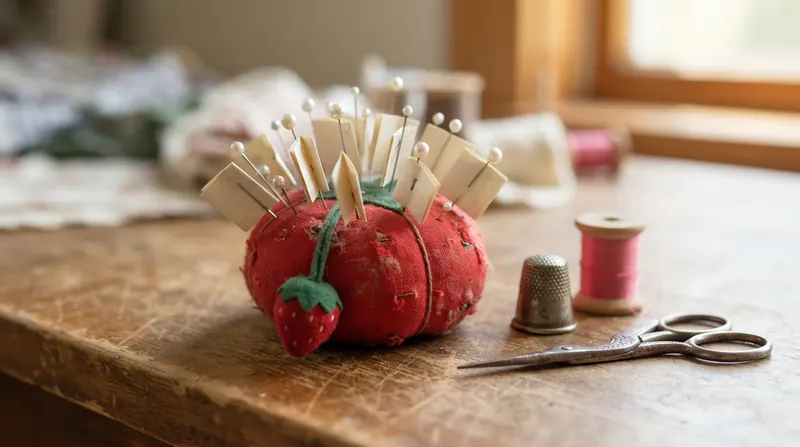
On Sunday nights I'd unpin the week, count the slips and write the number in the back of my club ledger.
Then the slips went into a mason jar on the windowsill, folded, so I could see them pile up.
My granddaughter Tessa, who is twenty-six and a dental hygienist in Bloomington, thought this was the saddest thing she'd ever heard.
Then she came for Easter, saw the jar and asked if she could start one.
The first week, the tomato caught nine slips. "Selvage" was on one of them, and so was "Bernadette," which I added afterward out of honesty.
The others were mostly nouns: "colander," "Mrs. Pruitt from the bakery," "the name of that actor in the train movie Frank liked."
I also wrote down the one time I couldn't find the word "thimble" while I was wearing one.
That's not a scientific finding. It's a dressmaker taking her own measurements twice and writing the number down before she can talk herself out of it.
I want to be clear about what the pincushion was for. It wasn't for proving anything to anyone; it was so I'd stop guessing.
Before the tomato, every dropped word felt like the beginning of the end of the world.
After the tomato, it was a slip, a pin and a number on Sunday night, and that I could live with.
What I Tried Before Anybody Brought a Box
I want to be honest about the month before Opal's box, because I think that's the part most columns skip.
A story that only lists what worked is a sales pitch in a cardigan.
So here's the inventory, with prices, the way I used to write up a ticket for a job that went sideways.
Item one: two books of word-search puzzles from the grocery checkout rack, $6.98. Tessa had read that puzzles were good for you, so I did one a night for three weeks.
I got very fast at finding the word "ORANGE" running backward on a diagonal. The tomato didn't notice.
Item two: a brain-games app on my phone at $11.99 a month, with cartoon owls that congratulated me for matching colored tiles.
I cancelled it in the second month. A dressmaker does not need an owl to tell her when she's dropped a stitch.
Item three: a third cup of coffee at three o'clock.
I thought maybe I was just tired at club time, so I started making a pot of coffee for myself while the rooibos steeped for everybody else.
My hands got a tremor at the teapot, which no hostess wants. And I was up at the kitchen window at midnight watching Bernadette's porch light, which didn't help anybody's Wednesday.
Item four: sticky notes, $8.49 for a twelve-pack, in every color they make. I labeled the drawers, the cupboards and the hook where the car keys go.
The sticky notes worked for the keys and nothing else. You can't put a sticky note on Bernadette.
Item five: a bottle of something from a magazine ad that I'll leave unnamed, because I took it twice, read the back of the bottle properly on the third morning and put it in the trash.
The ad had a woman in a lab coat on it. The back of the bottle had eleven ingredients I couldn't pronounce and no telephone number for anybody in the United States.
That one taught me something I already knew from forty-one years behind a counter.
If a garment doesn't have a label sewn in with the maker's name, you don't let it near a bride.
Why the Afternoon Is the Hour Nobody Fits
Every seamstress knows that a dress can fit perfectly at ten in the morning and pull at four in the afternoon.
People change shape over a day, and so does everything else about them.
I'd noticed for years that the words slipped worst in the afternoon. The morning was clear enough for a crossword in pen;
by three o'clock, the drawer where I keep the names felt a little stuck.
I'm not telling you that's a medical fact. I'm telling you it's what I saw in my own ledger, because the slips had a time written on the back.
Seven of the first nine were after two o'clock. Four were within an hour of club time.
Three o'clock is a funny hour when you're seventy-one.
Lunch is behind you, supper is a long way off, and if you sit down in the good chair with a library book, the book wins about half the time.
For nineteen years, the club was the thing that kept three o'clock awake in my house. Nine people talking at once will do that.
But the club is one afternoon a week. The other six, three o'clock was me, the wall clock and whatever was in the cup.
And for six weeks that winter, what was in the cup was a third pot of coffee I didn't need. That's the hour Opal walked into, though I didn't know she'd noticed.
Grandma, Mom says you're pinning words to a tomato? Are you okay?
6:48I'm keeping count, sweetheart, nine this week. It's a ledger, not a crisis.
6:52That's the most Grandma sentence ever. Can I come see it at Easter?
6:53Bring your own tomato. And the deviled eggs.
6:55Opal Brings Something to the Second Tuesday of March
Opal Fairweather was the head of circulation at the Galesburg Public Library for twenty-eight years.
She is seventy-eight now and she still reads the back of everything, including cereal boxes and the warranty cards for toasters.
She came to the second Tuesday of March twenty minutes early, which she never does.
She had a red box in her tote bag and a look on her face I've seen on librarians handing you the book you didn't know you'd asked for.
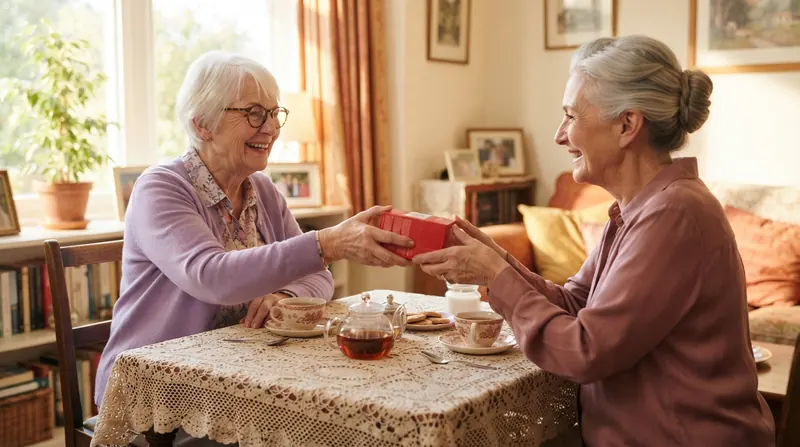
"I'm not saying anything about Bernadette," she said, setting it on the sideboard. "I'm saying you've been drinking coffee at three o'clock for six weeks, and your hands shake at the pot."
Then she tapped the box: "This has no caffeine, it brews dark like the rooibos, and it has a rose on it.
I thought the club might like a second pot."
That was all she said that afternoon. Opal doesn't make speeches; she makes recommendations and lets you check them out.

I asked her later, at the library steps, why that box in particular. She'd ordered it from the company's own website, she said, looking for something for her own three o'clock.
"I read the whole panel on their page before I ordered," she told me.
"There was a phone number for a real company in California, and the ingredients were things I could picture on a kitchen table."
"Carob, chicory, barley, dates, figs, rose petals. And two I had to look up when I got home, which is how I knew it was worth bringing you."
The two she'd looked up were rhodiola root and lion's mane.
She'd come home and spent an evening in the library's health database, which retired librarians can still get into, and nobody's going to stop them.
"There's some research," she said, "not a lot, and not on this box.
"But it's real research, and the amounts are printed on the panel, and I thought you'd want to read it yourself before you poured it for anybody."
That's the kind of friend Opal is. She doesn't tell you a thing works; she hands you the file and trusts you to read it.
Why a Librarian Trusts a Panel Over a Promise
I asked Opal for this column why she brought it to me instead of just drinking it herself.
She thought about it for a long time, the way she used to think about whether to recommend a book to a patron.
"Because you and I have the same problem at three o'clock," she said, "and you're the one who owns the teapot."
Then she said something I wrote down.
"I spent twenty-eight years watching people check out the book with the loudest cover. The good ones usually have a plain cover and a long bibliography."
Opal has her own tomato, she confessed, though hers is a notebook in her purse. She writes down every title she can't remember when somebody asks what she's reading.
"I've had the notebook since 2019," she said. "It's not a crisis; it's a list.
"A list is something you can do something about, and a crisis isn't."
I asked her whether she believed the tea would help. She looked at me over her glasses the way she used to look at people who returned books with the jackets torn.
"I believe it's a better three o'clock than a third pot of coffee," she said.
"Past that, I believe the research is small, and I believe in reading it before I believe in it."
Then she said, "Read the panel, Clem," the way my mother used to say "Measure twice."
So that's what I did next, at the kitchen table, with my reading glasses and the good lamp.
Did you read the panel, or is it sitting there on the sideboard?
7:31Twice. It's in the cupboard until I've read your envelope too.
7:36Good. Mavis says she'll bring the lemon bars if you make a second pot.
7:37Tell her the rooibos stays. The rose one goes on the side.
7:39The Box, Read the Way I'd Read a Pattern Envelope
A pattern envelope tells you everything if you read it in the right order. The picture on the front is the promise;
the back is the truth, in yardage and notions and seam allowances.
So I turned the box around before I ever opened it.
Here is what the seller's page and the panel say, line by line, the way I'd read it to a bride who wanted to know why her dress costs what it costs.
Line one: the name. Lion's Mane Rhodiola Rose Mushroom Herbal Tea, made by Teeccino, a company in Santa Barbara that the seller's page says has been blending since 1993.
The "Rose" in the name isn't decoration. There are real rose petals in it, and natural rose flavor at the end of the list.
Line two: the format. Twenty-five tea bags in the box, and the seller says each bag holds six grams of herbs, where a standard tea bag holds about two.
That matters for the cup and for the price, and I'll come back to both. A six-gram bag is a plump little sachet, I will say that.
Line three: caffeine. The front says caffeine free, and nothing on the ingredient list is a coffee bean or a tea leaf from the tea plant.
Line four: the ingredients, in order. Carob pods, chicory root, barley, dates, rose petals, rhodiola root, lion's mane extract, figs and natural rose flavor, with every one of them marked certified organic.
On a pattern envelope, the first fabric listed is the one you need the most yardage of. On a food label, it works the same way:
carob is the biggest share of the bag, and rose flavor is the smallest.
Line five: the amounts. Only two ingredients carry a number.
Rhodiola root, *Rhodiola rosea*, 300 milligrams; lion's mane extract, *Hericium erinaceus*, fruiting body and mycelium blend, 300 milligrams.
I liked that they printed those two.
Most of the boxes I'd looked at in February hid every amount behind the words "proprietary blend," which on a pattern would be like hiding the yardage.
Line six: the panel itself. It's a Nutrition Facts panel, the kind on a box of crackers, not the other kind you see on bottles in the vitamin aisle.
One bag: ten calories, zero grams of sugar and zero added sugar, twenty milligrams of sodium.
It also lists 390 milligrams of inulin, which the panel calls soluble fiber, and which comes from the chicory root.
Line seven: the allergy line, "Produced on machinery that also processes almonds." Pearl has a nut allergy, so that went in the club ledger in red pencil.
And barley is on the list, which means I wouldn't hand it to anybody avoiding gluten without asking the company first.
I found no gluten-free claim anywhere on the page, and I didn't invent one.
Line eight: the organic line. The seller says 85 percent organic.
Every ingredient carries the little organic star, so I take the 85 to be about the weight of the finished bag, though I'd ask on the phone if it mattered to me.
Line nine: the maker. A real phone number, 1-800-498-3434, answered weekdays from nine to five Pacific, a postal box in Santa Barbara and an email address.
That's a label sewn in with the maker's name. After the bottle from the magazine ad, that alone was worth the price of reading it.
And then the line that matters most for this column, the one I'd underline for any customer.
The box doesn't make a single printed promise about words, names or the drawer where you keep them.
The seller's page does use the words "focus, memory, and mental clarity" about lion's mane as an ingredient, and I'll tell you honestly what I found when I went looking for the research behind that.
But that's the ingredient's reputation, not a finding on this box.
What the Studies Say About the Two Headline Ingredients
Opal's envelope had two printouts in it, with yellow highlighter, the way she used to leave articles for the library board.
I went to the public library on Thursday and read a third one myself.
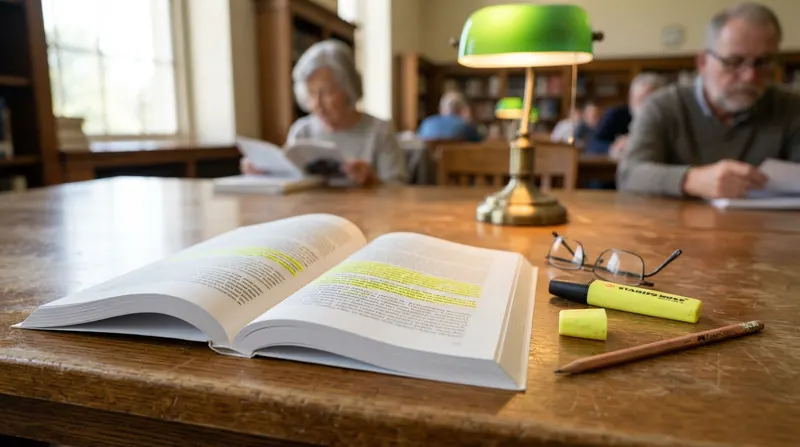
I want to give you all three the way I'd give a bride the bad news about a fabric:
the good part, the size of it and the fine print, all in one breath.
The first study is the one Opal highlighted twice. In Japan, thirty-one healthy adults over fifty took a lion's mane preparation or a placebo every day for twelve weeks.
The lion's mane group was associated with higher scores on a standard mental-status test, compared with the placebo group. [1] That's the good part, and it's real.
Now the size of it.
Thirty-one people is a small study, about the size of three Tuesday clubs put together, and a second test in the same study, one for visual memory, didn't change.
And the fine print, which matters most to anybody holding this box.
The daily amount in that study was 3.2 grams of the mushroom's fruiting body, and one tea bag carries 300 milligrams of lion's mane extract.
I did the arithmetic at the library table with a pencil.
You would need something like ten or eleven bags a day to match the study's amount, and the bag's extract isn't the same preparation as the study's anyway.
The second study is newer and smaller in time. In Britain, forty-one healthy adults aged eighteen to forty-five took a single 1.8-gram dose of lion's mane or a placebo. [2]
An hour later, the lion's mane group was associated with faster performance on a color-and-word task that measures attention.
But twenty-eight days of the same daily dose produced only a non-significant trend on a self-rated questionnaire.
So: young adults, one dose, an effect at sixty minutes on one task, and six times the amount in a tea bag.
Opal had written "NOT US" in the margin, which is fair.
The third study is the rhodiola one, which I found myself. Fifty-six young physicians working night shifts took a standardized rhodiola extract, called SHR-5, or a placebo, once a day.
During the first two weeks, the rhodiola group was associated with better scores on tests given in the small hours: associative thinking, short-term recall, calculation, concentration and speed of perception.
The authors reported no adverse effects.
That's a real result in a careful kind of study, where everybody takes both the extract and the placebo at different times.
But it was young doctors on night duty, a standardized extract, and two weeks, and the study didn't print the milligrams in the summary I could read.
So I can't tell you how the 300 milligrams of rhodiola root in a tea bag compares. Nobody can, from that study, and I'd distrust anyone who said otherwise.
Here's what I took away from Opal's envelope, and what I'd tell the club.
The two ingredients with the famous names have been studied, in small groups, at bigger amounts than this box carries, in people who weren't us.
That's not nothing. It's also not a reason to expect anything from a cup at three o'clock except a warm cup at three o'clock.
I decided I could live with that, the same way I lived with forty years of brides who wanted a size six and needed an eight.
You work with what's actually in front of you.
One Bag, Boiling Water and Six Minutes on the Wall Clock
The seller's direction is short.
"Use just as you would any other tea bag," it says, and steep it five to seven minutes for a strong, rich flavor, or take it out sooner if you like it mellow.
I settled on six minutes, timed by the wall clock above the sideboard, because I can see the long hand from the kettle without my glasses.

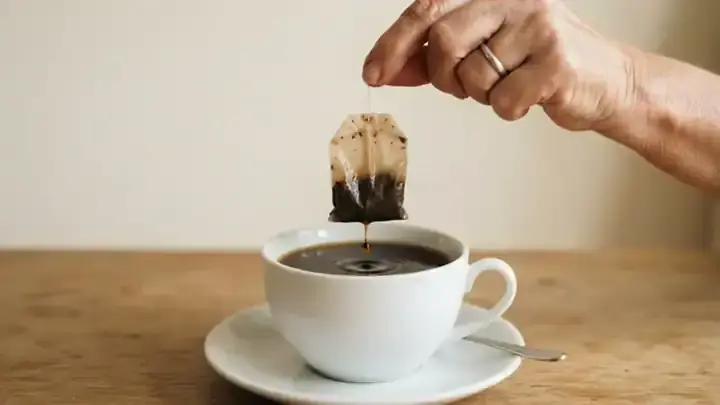
The first thing you notice is the color. It doesn't brew like tea; it brews like coffee, a deep roasted brown, darker than our old rooibos by three shades.
The second thing is the smell, which is the reason I kept making it.
Roasted grain first, then something sweet like dates, then, right at the end when it cools a little, roses.
Not a perfume rose. More like the bowl on my shop counter in August, when the petals had dried and gone soft and smelled faintly of tea themselves.
The taste is roasted and a little sweet without any sugar in it. Mavis said it tastes "like a coffee that went to finishing school," and I can't do better than that.
Gus put milk in his, which the seller's page suggests for their other blends.
He says it tastes like the malted milk his mother made in 1955, and he has had two cups every Tuesday since.
Pearl didn't like it at all.
"It's a breakfast drink pretending to be a tea," she said, and she went back to the rooibos pot, which is exactly why we keep two pots.
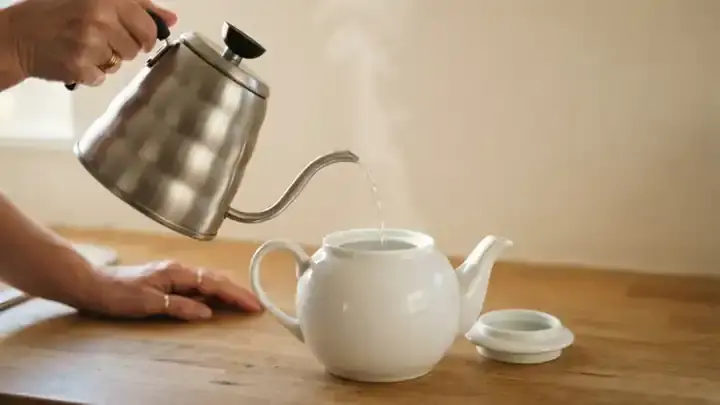
A practical note for anybody hosting. Six grams is a big bag, and I found one bag makes one generous cup, about eight ounces;
I tried stretching one bag across two cups for the club and it came out thin.
The bag squeezes out a lot of liquid when you lift it, too.
I keep a small saucer by the cups, the kind I used to use for pins, for the spent bags.
Five Things This Cup Is Not, Written Down Before Anything Else
Before I poured it for the club, I wrote a list on an index card and propped it against the sugar bowl.
I want to share it here, because I think the list of what something isn't is half of knowing what it is.
It isn't coffee: there's no coffee bean in it and no caffeine.
It looks like coffee in the cup, and that fooled Gus for two Tuesdays, but it's carob, chicory and barley, roasted.
It isn't tea from the tea plant, either. Black, green and oolong tea all come from one plant that has caffeine; this box has none of that plant in it.
"Herbal tea" is the honest name, the same way rooibos is an herbal tea.
It isn't something you swallow with a glass of water. It's a tea bag, a teapot and six minutes, and I'd never have tried it otherwise.
I've had enough little bottles in my cupboard for one life, and I'm not adding another. A cup is a thing you sit down with; you can't sit down with a bottle.
It isn't a substitute for the clinician.
I mentioned the slipped name at my spring checkup before I'd had a single cup, and I'd tell anybody to do the same.
My clinician listened, asked about my sleep and my hearing, and checked a few things.
She said one slipped name at seventy-one is a slipped name, and she wrote "keep doing the club" in my chart, which I thought was the best thing anybody's written about me in years.
And it isn't a promise. The box doesn't make one, the studies don't make one, and I won't make one either.
The seller's page carries the standard sentence that its statements haven't been evaluated by the Food and Drug Administration. I'd say the same about mine.
That chart is the reason Opal brought the box in the first place.
My three o'clock pot of coffee was about a hundred milligrams a cup, by the government's own rough figure, and I was drinking two. [4]
The rose tea is zero.
I didn't notice anything remarkable the first week except that my hands stayed still at the teapot and I wasn't at the window at midnight watching Bernadette's porch light.
Nine Things in the Bag, Pictured on My Kitchen Table
Opal's rule is that you should be able to picture every ingredient on a kitchen table.
So I laid out what I could find at the Hy-Vee and the health food co-op, and took a picture for Tessa.
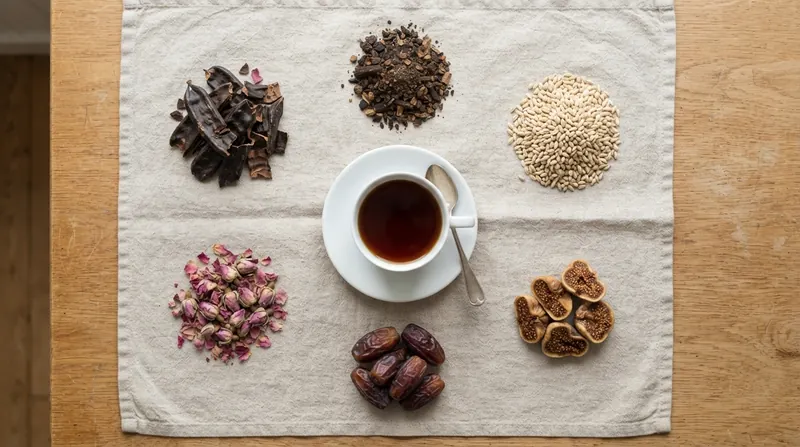
Carob pods come from a Mediterranean tree, and they taste a little like cocoa without being cocoa. They're the first ingredient, so they're most of what you taste.
Chicory root is the coffee stretcher every grandmother in New Orleans knows. Roasted, it's bitter and dark, and it's where the panel's inulin comes from.
Barley is roasted, the way barley tea is in Korea and Japan. It gives the cup body, the way a lining gives a jacket shape.
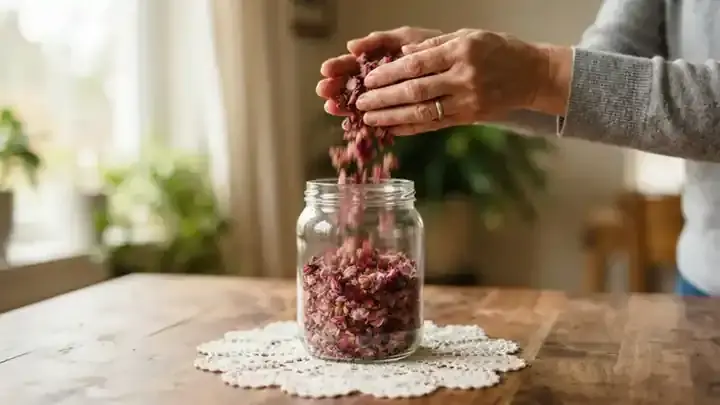
Dates and figs are there for sweetness, and the panel still shows zero grams of sugar per bag. The sweetness is faint, the way milk is faintly sweet.
Rose petals and natural rose flavor are the part I fell for, I'll admit it.
They're the first thing you smell when you lift the lid of the box and the last thing you taste.
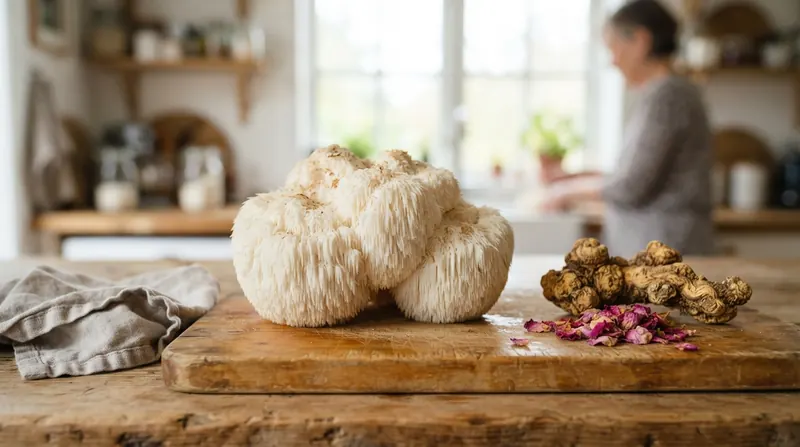
Rhodiola root grows in cold, rocky places in the far north and the high mountains.
Its common name is roseroot, because the cut root smells faintly of roses, which is how a box can be named "Rose" twice over.
Lion's mane is a mushroom, and I'd never seen one until the co-op had them in a basket in April.
It looks like a white pompom made of icicles, and it grows on hardwood trees.
The co-op man said people sauté it in butter like crab.
I bought one and tried that, and I'll tell you it's very good, and it has nothing to do with this column.
In the tea, lion's mane is an extract of the fruiting body, which is the part you'd cook, blended with the mycelium, which is the root-like threads underneath.
The panel says so plainly, and I respect a label that tells you which part of the plant you're getting.
That's nine things, and I can picture every one of them on my table. Opal's rule passed, and I'd ask you to hold any box you're considering to the same standard.
What 1,814 Ratings Can and Can't Tell a Hostess
A good alterations shop runs on word of mouth, so I always want to hear what other customers said.
The seller's page shows an average of 4.6 stars from 1,814 ratings for this tea.
That's a lot of people, more than the whole population of the town my mother grew up in.
And 4.6 of 5 is a good average for anything you eat or drink, where tastes run in every direction.
But I want to be honest about what I couldn't read.
The reviews on the seller's page load in a box that didn't show me the words people wrote, only the number and the count.
So I'm not going to print reviews I couldn't read.
I could have made up three nice ones with names and towns, and plenty of pages do, but I didn't, and you'd have had no way of knowing.
What I can tell you is what the number can and can't mean.
A 4.6 says most people who bothered to rate it liked the taste and the service. It doesn't say what it did for anybody's three o'clock, and it can't.
If you want to read the reviews yourself, they're on the company's page under the product. I'd read the three-star ones first; that's where people are most honest about a thing.
In the meantime, I have something better than strangers' reviews. I have nine people in my parlor every Tuesday with no reason to be polite to me.
Nine Cups, Two Pots and One Honest Club
On the third Tuesday of March, I set out both pots:
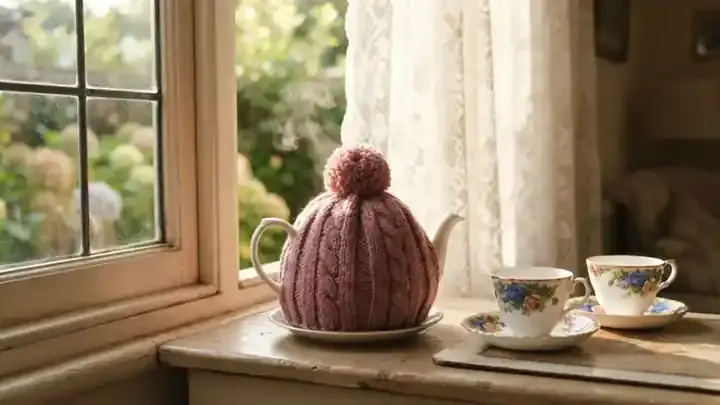
the old rooibos in Frank's brown Betty, and the rose tea in the white porcelain pot with the knitted cozy Mavis made me in 2011.
I didn't tell anybody which was which.
I just said "two pots today, try both, tell me the truth," and then I got out my club ledger and wrote down what they said.
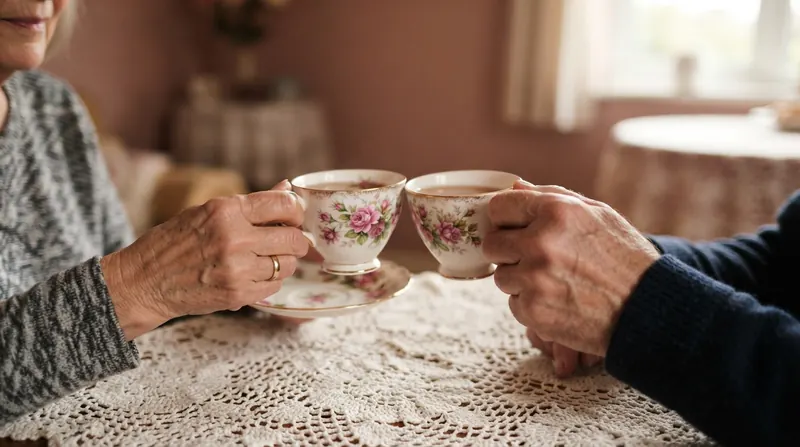
Mavis: "The white pot: it smells like a garden party and tastes like toast. I'll have another."
Gus: "Is the white one coffee? It's not coffee, but whatever it is, I want milk in it."
Pearl: "The brown pot, always. The white one tastes like breakfast cereal, and I don't want breakfast at three o'clock."
Dee: "White pot, but only after it cools down. Hot, it's just roasted; warm, you get the roses."
Bernadette: "Both. I'm not choosing between Frank's tea and the new one in this house, Clem, and you can't make me."
June-Ellen, at her second club ever, said "the white pot" very quietly and then asked me for the name of it on a recipe card, which was the most useful review of all.
Opal wouldn't vote, because she'd brought the box and said that disqualified her. Opal has always been unbearable about conflicts of interest.
My own vote: the white pot at three o'clock, and the brown pot at four, when Frank used to come through.
Six of nine liked the rose tea, two preferred rooibos, and one refused to choose. That's not a study and I'd never call it one;
it's my club ledger, and it tells you what a parlor full of opinionated people thinks of the taste.
Twelve Weeks of Slips, Good Weeks and Bad Ones
I promised myself when I started this column that I'd show you the tomato honestly, including the weeks that made me want to throw it in the button box.
So here are twelve weeks of slips, from the second Tuesday of March to the end of May. The rose tea was in the cup most afternoons at three;
so were a lot of other things, which I'll get to.
Clementine's pincushion ledger, March to May
- Week 1Rose tea at three o'clock six days of seven; coffee pot retired to the basement. Nine slips, the same as the week before. "Colander" again.
- Week 2Eleven slips, the worst week yet. A cold, a missed Tuesday, and the word "buttonhole," which I've sewn about forty thousand of. Nearly gave the box back to Opal.
- Week 3Eight slips. Started walking to the library and back with Opal on Mondays and Thursdays, a mile and a quarter each way.
- Week 4Club birthday for Pearl, two cakes, and a long night. Nine slips, two of them names. Wrote them down and didn't scold myself.
- Week 6Six slips. Started the newspaper crossword in pen with Opal at the library on Thursdays. Introduced two new members by name without a pause.
- Week 9Tessa and her boyfriend for the long weekend; no three o'clock cup for four days, and a late night of cards. Ten slips. Wrote "company, not crisis."
- Week 12Five slips, and one of them was "selvage" again. I laughed out loud and pinned it right at the top.
I want you to look at week two and week nine as carefully as week twelve.
The bad weeks are the truest part of any ledger, and anybody who shows you only the good weeks is selling you a pattern that won't fit.
Week two was a cold, a missed club and a hard week, full stop.
I nearly quit the whole business, cup and pincushion together.
Opal talked me out of it on the library steps.
"You don't throw out a pattern because the first muslin pulled," she said, which is a sewing sentence she stole from me in 2009.
Week nine was my granddaughter in the house, cards until midnight and no three o'clock cup for four days. Ten slips, and I'd do every one of them again.
And here's the part I owe you, in plain words.
Between week one and week twelve I also started walking with Opal twice a week, doing the crossword in pen, and writing the names on the back of the club's place cards before Tuesday.
So I can't tell you which of those things did what.
Maybe it was the walking, or the crossword, or the place cards, or the cup, or the spring, or nothing at all except a woman paying closer attention.
What I can tell you is that the number in the back of the ledger went from nine to five, with an eleven and a ten along the way.
And I can tell you I stopped dreading three o'clock, which was worth the box all by itself.

Morning, Mrs. Duvall, your order is ready whenever you're by the store.
9:05Thank you, Raymond. After the library walk, around eleven, if the line isn't out the door.
9:12Tuesdays are quiet. My mom wants the name of that rose tea Gus keeps talking about.
9:13I'll write it on a recipe card and bring it with me.
9:15What My Clinician Said About a Jar of Paper Slips
At the end of May I had my regular checkup, and I took the mason jar in my tote bag. I don't know what I expected;
I just wanted somebody with a stethoscope to see it.
My clinician is a careful young woman who types while she listens and turns the screen toward you when she's done.
She took the jar, turned it in the light and read a few slips out loud.
"Colander," she said, "selvage. What's selvage?"
I told her, and she laughed and said she'd had to look up "rickrack" once at her grandmother's house.
Then she said the thing I've been thinking about all summer.
"Most people who are worried about this never write anything down. They just worry."
She asked what else I'd changed since March.
I told her about the walks with Opal, the crossword, the place cards, the club and the three o'clock cup with no caffeine instead of the coffee pot.
She wrote some of it down.
She said the walking and the company were the parts she'd bet on, and that a cup of something without caffeine at three o'clock instead of two cups of coffee was "a reasonable trade."
She didn't say the tea did anything, and I didn't ask her to.
She said, "Keep the jar, keep the walks, keep the club, and come back in the fall," and I wrote that on the inside lid of my sewing box.
I'll be honest that I felt a little silly walking out of there with a jar of paper in my tote.
But I felt less silly than I did standing in my own parlor in February, waiting eleven seconds for Bernadette's name.
Where the Cup Actually Fits in a Day
I think people imagine a column like this ends with a woman transformed.
So let me tell you about an ordinary Tuesday in June instead, hour by hour, the way I used to write up a fitting.
Seven o'clock: coffee, one cup, the real kind, with the newspaper. I never gave up morning coffee and I never will.
Nine o'clock: the crossword in pen. If a word goes missing, it goes on a slip, but crosswords are cheating, because the squares tell you how many letters.
Ten-thirty: the library walk with Opal, a mile and a quarter each way, past the courthouse where Dee gets her gossip and the bakery where Mrs. Pruitt finally has a name again.
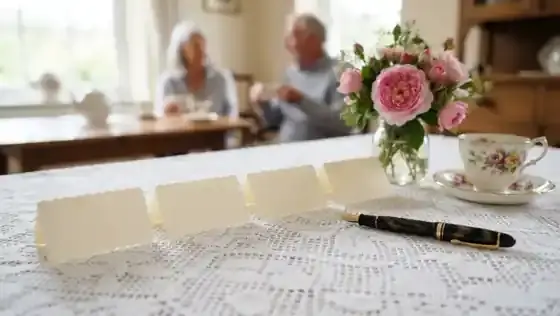
Noon: lunch, usually soup. One o'clock: the place cards;
I write each member's name on the back of a card in pencil, which I started doing in April and which my mother would have called fussy.
Two-thirty: the kettle goes on.
I put the rose tea in the white pot with Mavis's cozy and the rooibos in Frank's brown Betty, and I set the long hand of the wall clock in my head for six minutes.
Three o'clock: the club, with nine cups, two pots, lemon bars, gossip, one argument about the city council and one about whether Gus should be allowed to bring store-bought cookies.
Four o'clock: the last of the brown pot, standing up, the way Frank took it. I say "Ladies" like a conductor, and Bernadette rolls her eyes every single week.
Seven o'clock: supper. Nine o'clock: the pincushion, where any slips from the day go on the tomato, and on Sundays they go in the jar.
That's it. The cup is one line in a day that has a dozen lines, and I'd be lying if I told you it was the most important one.
The most important line is the club.
Nine people who expect you at three o'clock, who will notice if you're not there and will tease you when you are, are worth more than anything I could buy in a box.
But the cup is the line that made three o'clock mine again on the six days the club doesn't meet.
And it's the line that let me retire the coffee pot to the basement without missing it.
How to Keep a Pincushion Ledger Like a Dressmaker
Several club members asked how to start their own, so here it is, the way I'd write it on a pattern instruction sheet.
You don't need the tea to do any of this, and I'd tell you to start the pincushion first.
Step one: pick a container you'll see every day, a tomato pincushion, a jar, a notebook in your purse like Opal's. It has to be in plain sight, or you'll stop.
Step two: write the word, not the worry.
The slip says "colander," not "I'm losing my mind."
The word is the measurement; the worry is just the weather.
Step three: write the time on the back. That's how I learned my afternoons were the hard hours, and that's what made me look at the three o'clock coffee pot.
Step four: count once a week, on the same day; Sunday night works for me.
Write the number in a ledger, a calendar or the back of a cookbook, and never erase a bad week.
Step five: write down what else changed. If you start walking or a crossword, write it down.
If you change what's in your cup, write that down too, so you don't give the credit to the wrong thing.
Step six: take the jar to your clinician, not to prove anything, just to show them. A jar of words is easier to talk about than a feeling.
Four Letters That Came to the Parlor
When a shorter version of this column ran in the club newsletter this spring, I got more letters than I've gotten since I closed the shop.
Here are four, shortened, with my answers, because I think the questions are better than anything I could write on my own.
"Mrs. Duvall, will this tea help my husband remember where he parks the car?" — from a woman in Kewanee.
I don't know, and nobody honest can tell you. The box doesn't promise it and the studies don't show it;
what I'd tell you is to try the pincushion first, and to take his slips to his clinician.
"Can I drink it if I take something every morning for my heart?" — from a man in Peoria.
Take the box to your pharmacist and show your clinician the panel before the first cup.
Rhodiola root and lion's mane are the two names I'd say out loud, because they're the two with amounts on the box.
"Isn't rooibos better for you?" — from Pearl, who mailed it to me from across town to make a point.
Pearl, rooibos is a lovely tea and Frank's pot isn't going anywhere. I'm not comparing them for anybody's health, only for the hour:
the club gets both, and you can keep pouring yours.
"Does the rose taste strong? I don't like perfumed teas." — from a retired band teacher in Macomb.
No, it's faint, mostly in the smell, and stronger as the cup cools. If you drink it hot, you'll mostly taste roasted grain;
if you hate rose, though, you'll find it, and you won't like it.
What Readers Wrote When This Ran in the Club Newsletter
A shorter version of this column ran in the spring issue of the club newsletter, which goes to about forty people in Galesburg and a few cousins out of state.
Here are some of the replies, shared with permission and with the names shortened.
I'll add one thing to Dolores's comment, because it's the one that made me cry at the kitchen table.
If you've stopped going somewhere because you're afraid of the eleven seconds, go back.
Everybody in the room has had their own eleven seconds, and most of them are relieved when somebody else has one first.
The comments above are shared from our newsletter's readers and lightly shortened;
they are composites in the sense that matters for a column like this, and they're printed for what they say about the habit and the taste, not as proof of anything.
Opal and I, Recorded for the Library Friends Newsletter

In June, the Friends of the Library asked Opal and me to record a conversation for their audio newsletter, which goes out to members who can't read the small print anymore.
We did it on my front porch with two cups and the wall clock ticking through the screen door.
Friends of the Library · Porch Conversations, Episode 6
Two Old Friends, Two Teapots and a Pincushion Full of Words
Clementine
host
Opal, the Friends want to know why a retired librarian walked into my parlor with a box of tea and an envelope full of studies.
 Opal
guest
Because your hands were shaking at the teapot, Clem, and you'd started drinking coffee at three o'clock like a long-haul trucker. Somebody had to do something, and a casserole felt like overreacting.
Clementine
host
You brought the studies too. Most people would have just handed me the box.
Opal
guest
Most people didn't spend twenty-eight years watching patrons check out the book with the loudest cover. I wanted you to read the small print before you poured it for nine people, and I wanted you to see that the amounts in the study were about ten bags' worth.
Clementine
host
I did the arithmetic at the library table: ten or eleven bags a day, a different preparation, and people who weren't us. So tell the Friends the honest version: why drink it at all?
Opal
guest
Because it's a dark, roasted cup with no caffeine and a rose in it, and it costs about eighty cents. It sat at your table at three o'clock while you walked with me, did the crossword in pen and wrote names on your place cards, and whatever happened to that jar, you did it with your feet and your pencil.
Clementine
host
And what would you tell somebody listening who's had their own eleven seconds this week?
Opal
guest
Write the word down, then tell your clinician, and go back to whatever group you stopped going to, because everybody there has had their own eleven seconds. And if three o'clock is your hard hour too, put the kettle on before you put the coffee on.
Opal's last line is the one the Friends put on the cover of the newsletter.
Put the kettle on before you put the coffee on, which my mother would have called common sense and the library calls good advice.
25 tea bags · one bag per cup · read the return terms before ordering
The Return Terms, Read Like a Pattern's Seam Allowances
I spent forty-one years explaining to people what I could and couldn't take back, so I read the company's return policy before anything else.
It's shorter than most, and stricter than some, and I want you to know it before you order.
First, where you buy matters. The policy covers products bought directly from the company's own website, Teeccino.com.
If you buy it from another store or online seller, including Amazon, the return goes back to that store, not to Teeccino.
Second, the window is 45 days from the date of purchase. That's longer than most return windows I've seen on a food.
Third, and this is the one to read twice: opened or partially used product isn't eligible for a return.
It has to come back in the original packaging, and you pay the shipping to send it back.
So this isn't a refund promise on a box you've tasted. If you open it and don't like it, the policy as written says that box is yours.
Fourth, if they made a mistake, they make it right.
If the company shipped the wrong thing or your package arrived damaged, the policy says they'll replace it and send you a prepaid return label.
Fifth, the phone. The policy asks you to start any return by calling 800-498-3434, extension 101, weekdays from nine to five Pacific, or by emailing info@teeccino.com.
A first-time customer can also call for help picking a flavor, the policy says, which I thought was a decent thing to put in writing.
Here's how I'd handle it, if I were you. Order one box, and if you're not sure, pour it for a friend before you decide whether to order a second.
That's what the Tuesday club is for, after all. Nine opinions on one box is cheaper than nine boxes.
Who This Box Is For, and Who Should Skip It
I measured a lot of people over forty-one years, and I learned that the kindest thing you can tell a customer is "this one isn't for you." So here's both lists, honestly.
- Your hard hour is the afternoon, and you'd like a warm cup at three o'clock without the caffeine of a coffee pot
- You want a dark, roasted cup that looks and tastes more like coffee than tea, with a faint rose at the finish
- You like a label where the amounts of the two headline ingredients are printed, not tucked into a blend
- You'd rather sit down with a teapot for six minutes than swallow something with a glass of water
- You'll keep your own pincushion, notebook or jar, and you'll take it to your next appointment
- You want a promise about names and words; nobody honest can give you one, and the seller's FDA line says so
- You avoid gluten (barley is on the list) or you have a nut allergy (the machinery also processes almonds)
- You only like light, flowery teas; Pearl would tell you this one tastes like breakfast
- You want the full amount used in the lion's mane studies; this bag carries about a tenth of it
- You're expecting, nursing, or take anything every day from your clinic, and haven't asked them yet
What a Cup Costs Against What I Already Spent
Every alteration ticket I ever wrote had a price at the bottom, so here's mine. I'll keep it simple, the way I'd explain it at the counter.
A box of 25 bags is $19.99, which is about 80 cents a cup. At one cup a day, every day, a box lasts a little over three and a half weeks.
At the club, where I pour about nine cups of the rose tea on a Tuesday, a box lasts about three Tuesdays if nobody's home the other six days.
I buy a box every three weeks, and Opal buys one for herself.
Compare that to my five weeks of receipts in February: about $79 on things I put in a drawer or a trash can.
The rose tea isn't the cheapest cup in the world, but it's the first thing I bought that winter that I actually used every day.
And compared to the third pot of coffee, it costs more per cup. I'll say that plainly, because it's true;
what I paid for was the hour without the shake in my hands, not a bargain.
Short Answers to the Questions the Club Asked
Short answers to the questions the Tuesday club asked me
How do you make it?
One bag per cup of hot water, steeped five to seven minutes for a strong cup, per the seller, or less if you like it mellow. I use one bag per eight-ounce cup and six minutes on the wall clock.
What does it taste like?
Roasted and dark, closer to coffee than to tea, with a little sweetness from the dates and figs and a faint rose at the finish that comes out as the cup cools. Gus takes it with milk; Pearl doesn't take it at all.
Does it have caffeine?
The box and the seller's page say caffeine free, and none of the nine ingredients is coffee or tea from the tea plant.
How much rhodiola and lion's mane is in a bag?
The panel prints 300 milligrams of rhodiola root and 300 milligrams of lion's mane extract, a blend of fruiting body and mycelium, in each bag. The other seven ingredients have no amounts printed.
Is it the same amount as in the studies?
No. The lion's mane study in adults over fifty used 3.2 grams a day of a fruiting-body preparation, about ten times one bag, and the rhodiola study used a standardized extract whose amount wasn't in the summary I could read.
Is there sugar in it?
The panel shows zero grams of total sugars and zero added sugar per bag, and ten calories. The sweetness comes from dates and figs in very small amounts.
Is it gluten free or nut free?
Barley is on the ingredient list, and the panel says it's produced on machinery that also processes almonds. I found no gluten-free claim; call the company if it matters to you.
Can I drink it if I already take something every day?
Show the box to your pharmacist and your clinician before the first cup. Rhodiola root and lion's mane are the names I'd say out loud.
Who makes it, and how do I reach them?
Teeccino, of Santa Barbara, California, blending since 1993 according to its page. Phone 1-800-498-3434, weekdays 9 to 5 Pacific; mail to PO Box 40829, Santa Barbara, CA 93140; email info@teeccino.com.
What if I don't like it?
Returns are accepted within 45 days for boxes bought directly from Teeccino.com, unopened and in the original packaging, and you pay the return shipping. Opened boxes aren't eligible, so if you're unsure, share your first box with a friend.
Where the Box Stands, Line by Line
Here's where I've landed, after a spring of two pots, one envelope and a jar full of paper. I'll put it the way I'd write a fitting card:
what fits, what doesn't and what needs another look.
What fits: the hour. A dark, roasted, caffeine-free cup at three o'clock suits a woman my age better than a third pot of coffee, and my hands agree.
What fits: the label. Nine ingredients I can picture, two with amounts printed, a food panel, a phone number and a mailing address in California.
What fits: the taste, for six of my nine club members. The rose is faint and the roast is strong, and it pours like coffee from a porcelain pot.
What doesn't fit: any promise. The studies behind the two headline ingredients are small, used bigger amounts, and weren't done on this box.
I wouldn't let anybody tell you otherwise.
What doesn't fit: the return policy, for the unsure; once it's opened, it's yours. Pour it for a friend before you buy the second box.
What needs another look: me, in the fall. My clinician wants to see the jar again in October, and I'll write you what she says, good or not.
25 tea bags · caffeine free · one bag per cup, five to seven minutes
If You've Had Your Own Eleven Seconds This Week
I'll end with what I'd tell a friend at my own counter, because that's the only advice I've ever been any good at.
First, write it down. A pincushion, a jar, a notebook in your purse: the word, not the worry, with the time on the back.
Second, tell your clinician, and take the jar. It's easier to talk about a jar of words than about a feeling you can't name.
Third, go back to whatever you stopped going to. The bridge group, the choir, the Tuesday club; everybody in that room has had their own eleven seconds.
Fourth, look at your three o'clock. If it's a third pot of coffee or a recliner that always wins, think about what else could be in the cup.
And fifth, if you order this box, read it the way Opal taught me: the panel first, the studies second and the return terms third, before you pour it for anybody.
P.S. The tomato pincushion sits on the parlor sideboard now, next to Mavis's knitted cozy and below the wall clock, and if you have an Opal in your life, thank her; if you are the Opal, bring the box and the envelope anyway.
P.P.S. Remember the order Opal and my clinician agreed on without ever meeting: the club, the walks, the jar, then the cup; the cup is the smallest of the four, and it's the only one that comes in a box.
The full ingredient guide, with a note on each of the nine ingredients and on reading the advertising around this box, is linked at the foot of this page.
First, the people: Clementine Duvall is a pen name. Opal, Bernadette, the Tuesday club and my granddaughter Tessa are composites, the way parlor columns have always been written.
Everything about the tea itself, its label, its price, its brewing directions, its star rating and its return terms comes from the seller's own pages, read in October 2026.